Bereavement & Probate House Clearance, handled with care
Clearing the home of someone who has died is not a rubbish job, and we do not treat it as one. We work at your pace and to your list. We set aside papers, photographs and anything of value, and nothing leaves the house without your say-so. Fixed prices across west London and South Bucks.
Single rooms from £195 • three-bed houses from £995 • keys from your solicitor or agent • waste paperwork on request
- Fixed price agreed before we collect
- Pay on the day, no deposit
- Goods-in-transit cover
- Same-day slots, often

Get a fixed price for your clearance
A few quick taps. Discreet, insured and fully cleared.
Would rather talk? Call 07400 640002 or send a photo on WhatsApp.
The short version
- Nothing leaves without your say-so. You give us a keep list, we walk through it with you, and we set aside anything that looks personal, important or valuable as we go.
- Fixed price before we start, from photos, a video call or a visit: a single room from £195, a three-bed house from £995, subject to survey. Labour, transport and disposal are included.
- You do not need to be there. We can collect keys from a solicitor, estate agent or neighbour and report back when the house is clear.
- Reuse and recycling first. Usable items go to reuse or charity where suitable, materials go to licensed recycling sites, and waste transfer paperwork is available for the estate’s records.
How a probate clearance works with us
Every estate is different, but most of our probate clearances follow the same six steps. You can stop, pause or change the plan at any point.
- A first conversation. Call, WhatsApp or send the form. Tell us the address, roughly how full the property is, and who is handling the estate. There is no obligation and no pressure to book.
- A walk-through. In person, on a video call or from photos of each room, loft, garage and shed. This is when you show us what stays: furniture going to family, boxes for the solicitor, items waiting for a valuer.
- A fixed, written price. One all-in figure covering labour, the van, transport and disposal. If you later find more than we priced for, you hear the new price before anything goes in the van, never afterwards.
- Access arranged around you. We can collect keys from a solicitor, estate agent or neighbour, work weekends, and split a large house over more than one visit.
- A careful clearance, room by room. Keep-list items are set aside and never loaded. We look out for papers, photographs, cash in books and jewellery in drawers, and put anything like that aside for you.
- Handed back empty and swept, ready for an agent’s photos, a valuation or a sale. Waste transfer paperwork for the load is available on request.

When to clear: timing around probate
Executors often ask whether they are allowed to clear the house yet. The honest answer is that it depends on the estate, and your solicitor or the person administering the estate should make that call. These general points from GOV.UK help with planning:
| Stage | What usually happens | Where a clearance fits |
|---|---|---|
| Straight after the death | Secure the property, find the will, tell the insurer and utilities | Too early for most families. Remove only perishables and anything that must not be left |
| Valuing the estate | GOV.UK says the estate, including household contents, must be valued before applying for probate. This can take several months | Have valuables assessed first. A partial clearance of obvious rubbish is often fine |
| Applying for probate | GOV.UK says you will usually get the grant within 12 weeks of applying, longer if more information is needed | Many executors book the main clearance now, with the contents already valued |
| After the grant | The executor can deal with the estate: pay debts, sell the house, distribute items | The usual time for a full clearance before marketing or sale |
Two clocks worth knowing about
If Inheritance Tax is due, GOV.UK says it must be paid by the end of the sixth month after the death to avoid interest, often before probate is granted. Separately, a home left empty after a death is usually exempt from Council Tax until probate is granted, and for up to six months afterwards while it stays empty and unsold. Check the current rules with the council, and check the home insurance too: many policies change their terms once a property has been empty for a set period.
The first weeks after a death: what can wait, and what cannot
Nobody has to clear a house in the first fortnight, and most families should not. In the early weeks, the jobs that matter are these:
- Secure the property. Lock up, take spare keys back from neighbours or carers if you need to, and tell the home insurer the house is empty. Many policies change their cover after 30 or 60 days of vacancy.
- Clear the fridge and perishables, empty the bins and stop newspapers and deliveries. That is the only clearing that cannot wait.
- Look for the will and the important papers before anything leaves: bank and pension letters, share certificates, premium bonds, the deeds, insurance policies, passports and the address book.
- Leave the contents in place until the executor knows whether they need valuing. GOV.UK says the estate, household contents included, has to be valued before probate is applied for.
- If it is a rented home, ring the landlord early. A council or housing association tenancy usually gives you about four weeks to clear once notice is given. See clearing a council house after a death.
Can you clear a house before probate?
Often, partly, yes. But the decision belongs to the executor, and if a solicitor is acting, ask them first. In general terms:
- Usually fine before the grant: clearing perishables and obvious rubbish, securing valuables and papers, and moving items for safekeeping, provided you keep a list.
- Usually wait until it is valued: furniture, jewellery, art, collections or anything that might be worth something. The value has to go on the estate figures, so get it valued before it is moved, sold or given away.
- Usually wait until the grant: selling the house, and giving items to beneficiaries in a way that cannot be undone if the estate later turns out to owe money.
A common pattern is a light clear before the grant (rubbish, perishables and papers), then the main clearance once the contents are valued or the grant arrives. GOV.UK says most grants arrive within about 12 weeks of applying. We are happy to do it in two visits and price it that way from the start.
Council and housing association homes: the four-week clock
If the person rented from the council or a housing association, the timetable is set by the landlord, not by probate. The tenancy does not always end automatically. If a spouse, partner or qualifying relative lived there, they may be able to take it over, which is called succession. Otherwise the landlord usually serves a notice, and Shelter England says you will typically have about four weeks to clear the property. Rent is normally charged to the estate until the tenancy ends and the keys go back.
That is where a fast clearance pays for itself: every extra week can mean another week’s rent from the estate. Ask the landlord for more time if you need it (many will agree), and ask whether they will accept a surrender on a set date. Our full guide to council house clearance after a death covers the steps, what "cleared" means to a council, and the free options.
When a parent moves into a care home
Clearing the home of someone who is still alive is a different kind of hard. They may want to know where their things went, so take it slowly. We usually do it in this order:
- Pack what goes with them first. Care homes usually have limited room, so ask the home what furniture is allowed: often a chair, a bedside table, photos, a radio or TV, and familiar bedding. We can deliver it to the care home on the same trip.
- Let the family choose next. Mark what relatives are taking, and we can deliver those too.
- Then clear the rest, with good furniture to charity where it can go.
Who can authorise it
If your parent can still make the decision, they decide. If they cannot, the person acting for them normally needs a registered lasting power of attorney for property and financial affairs (or a deputyship order) to deal with their home and belongings. See GOV.UK on power of attorney.
The 12-week property disregard (England)
If your parent owns their home and moves permanently into a care home, the council must ignore the value of the home in the care-fees means test for the first 12 weeks. That gives the family time to decide whether to sell, let it, or agree a deferred payment. The home can also be disregarded for longer if a partner, or a relative over 60 or incapacitated, still lives there. Independent Age and Age UK explain the rules in full. For clearing, the practical point is that 12 weeks passes quickly if the house is going on the market, so book the clearance early.
Who pays for a house clearance after a death?
Normally the estate does. A house clearance is a cost of administering the estate, like the funeral or the solicitor, so the executor pays it from the estate’s money before anything is shared out. If a relative pays upfront because the bank accounts are frozen, they can usually claim it back from the estate. Keep our receipt and the waste paperwork for the executor’s accounts.
Family members are not usually personally liable for the clearance, or for a council tenancy’s rent, just because they are related. The exceptions are a joint tenant, someone who signed as a guarantor, or someone who personally agreed to pay. If the estate has little or no money, tell the landlord and the executor early, and use the free routes below to keep the bill down. Our house clearance cost guide shows exactly what to budget.
Probate house clearance cost: worked examples
A probate clearance costs the same as any clearance. There is no estate surcharge. These examples use our published from prices and eco fees, each confirmed after a free survey:
| Estate | How it adds up | From (subject to survey) |
|---|---|---|
| Mum’s one-bed council flat: sofa, bed, fridge-freezer | One-bed £495 + sofa £44 + mattress £33 + fridge £55 | from £627 |
| Two-bed bungalow, family has taken the good furniture | Two-bed £750 + 2 mattresses £66 + fridge £55 | from £871 |
| Three-bed semi with a full loft and garage: suite, three beds, fridge, freezer | Three-bed £995 + 3 seats £132 + 3 mattresses £99 + 2 × £55 | from £1,336 |
| Light clear before the grant, main clear after | Single room for papers and perishables, then the property tier | from £195, then the property tier |
What pushes it up: a packed loft or garage, upper floors with no lift, and a property that has not been lived in fully for years. What brings it down: the family taking what they want first, and a free charity collection for good furniture. All the detail is in our house clearance prices and cost calculator. Fully insured, licensed waste carrier, with a waste transfer note for the estate file.
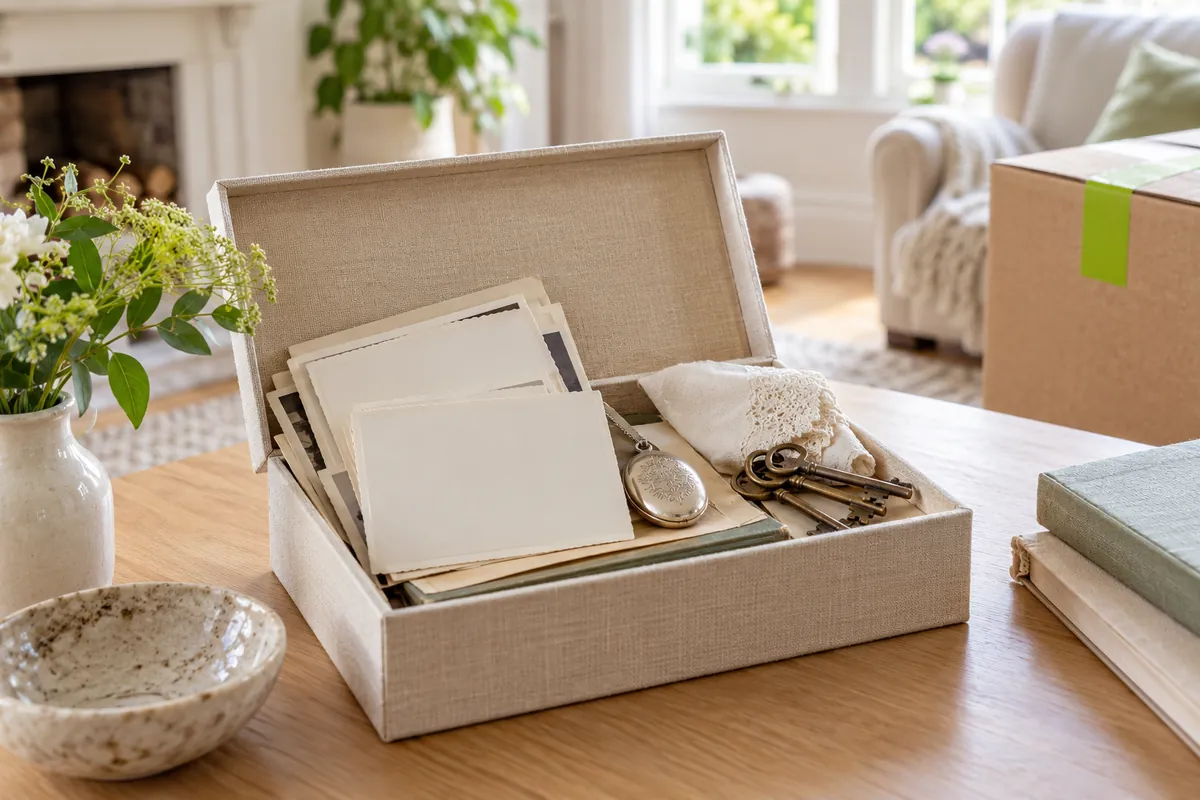
What we set aside for you: the keepsakes and documents checklist
Before and during every bereavement clearance we look for these, and anything we find goes into the "keep" room rather than the van. Add your own items to the list when we walk through:
| Look for | Where it hides |
|---|---|
| Wills, deeds and letters from banks, pensions or solicitors | Bureaus, filing boxes, kitchen drawers and the backs of wardrobes |
| Cash | Inside books, coat pockets, handbags, biscuit tins and under mattresses |
| Jewellery and watches | Bedside drawers, dressing tables, shoe boxes and sewing boxes |
| Photographs, slides, cine film and letters | Lofts, under beds and the top of wardrobes |
| Medals, certificates and service records | Display cases, frames and document wallets |
| Premium bonds, share certificates and savings books | With the household papers, often in envelopes |
| Keys, phones, laptops and tablets | Hall drawers and bedside tables. Keep devices for the family, as they hold photos and accounts |
| Anything the will names | Ask the executor for the list before the day |
We do not value, buy or sell contents. If something might be worth having appraised, it stays out of the van until you have had it looked at.
Working with executors, solicitors and estate agents
A lot of our probate work comes through the person handling the estate rather than the family directly, and we are set up for that:
- One point of contact. We take instructions from the executor or administrator, or someone they name, and nobody else.
- Remote jobs. We collect keys from your solicitor, estate agent or neighbour and return them afterwards, so you do not have to travel.
- A written scope. The keep list and the price are agreed in writing before the clearance day, so everyone involved can see what was agreed.
- Paperwork for the file. Waste transfer paperwork for the load is available on request, so the estate can show its waste went through a legitimate route. We are a registered waste carrier with the Environment Agency. Ask us for the registration details for your collection and check them on the public register before we load.
- Sale-ready timing. We can time the clearance around an agent’s photos, a valuation or a completion date.
What happens to the contents
This is the question families ask most, and it deserves a straight answer. Everything in the house ends up in one of these routes:
| What it is | Where it goes |
|---|---|
| Your keep list: family furniture, photographs, papers, keepsakes | Set aside in a room you choose and never loaded. We can deliver it to a family member or to storage in the same trip if you need |
| Possibly valuable: antiques, jewellery, art, collections | Keep it out of the clearance and have it valued first. We do not buy, value or sell contents |
| Usable furniture and household goods | Reuse or charity where suitable |
| Metal, wood, cardboard, textiles, electricals | Separated at licensed recycling centres and transfer stations |
| Sofas, armchairs and other upholstered seating | By law these must be kept separate and incinerated, because of persistent organic pollutants. That is why they carry their own disposal fee |
| Hazardous items: paint, chemicals, gas bottles, asbestos | We cannot carry these in a general load, and we will tell you the right route |
We do not publish a recycling percentage, because the final sorting happens at the transfer station after our van has left, and we will not claim a figure we cannot evidence. What we can tell you is the route each type of item takes, and give you the paperwork for it.
Probate clearance prices
A probate clearance is priced like any house clearance: by the size of the property, how full it is, and how easy it is to get things out. There is no extra charge for the job being an estate.
| Property | Guide price | What is included |
|---|---|---|
| Single room | from £195 | One bedroom, box room or lounge cleared |
| One-bed flat | from £495 | Whole flat cleared and swept |
| Two-bed home | from £750 | A typical two-bedroom house or larger flat |
| Three-bed house | from £995 | A typical three-bedroom family house, loft and garden included |
| Four-bed+ / large house | from £1,450 | Four bedrooms or more, or a large, very full property |
What moves the price: how full the rooms are, lofts, garages and sheds, stairs with no lift, and the number of sofas and mattresses, which carry their own published disposal fee (an armchair from £65, a mattress from £85). What lowers it: taking out anything valuable or wanted before the day, and letting us send usable items to reuse rather than treating everything as waste. Our house clearance cost guide explains the full breakdown.
Your options as an executor, compared
| Option | Good for | The catch |
|---|---|---|
| Family clear it themselves | Small flats, when people live nearby | Weeks of weekends, a van, and the tip’s permit and DIY rules |
| Council bulky collection | A handful of large items | Kerbside only, limited items per booking, not a whole house |
| Skip on the drive or road | Renovation waste after the clearance | Someone still has to carry everything out. A road permit costs up to £189.63 locally |
| Probate clearance (us) | Most estates: one visit, one fixed price, nothing to lift | We do not value or buy contents, so get valuables assessed first |
If you are in the Gerrards Cross area, our Gerrards Cross probate clearance guide covers the local side, from Buckinghamshire’s tips to the questions executors there ask most.
House clearance prices
Priced by the size of the property and how full it is, with labour, transport and disposal included. Every figure is a from price, confirmed after a free survey from photos, a video call or a visit.
One bedroom, box room or a cleared-out lounge.
A full one-bedroom flat cleared and swept.
A typical two-bedroom house or larger flat.
A typical three-bedroom family house, loft and garden included.
Four bedrooms or more, or a large, very full property.
Every price is a from price, subject to survey: we confirm it after a free survey (photos, a video call or a visit) and fix it before we start — no hidden fees.
A probate clearance in four steps
Talk it through
No obligation. Tell us about the property and who is handling the estate.
Walk-through and keep list
In person, on video or from photos. You decide what stays.
Fixed written price
One all-in figure. Any change is agreed before loading, never after.
Cleared and handed back
Room by room, keep-list items set aside, swept and ready.
Bereavement & probate house clearance: your questions answered
Can you clear a house before probate is granted?
Often partly, yes, but it is the executor’s decision, so take advice first if a solicitor is involved. GOV.UK says the estate, contents included, must be valued before you apply for probate. Many executors have valuables assessed, clear the obvious rubbish and papers early, then do the main clearance once the contents are valued or the grant arrives.
How much does a bereavement or probate house clearance cost?
The same as any clearance, with nothing extra because it is an estate: from £195 for a single room, £495 for a one-bed flat, £750 for a two-bed home, £995 for a three-bed house and £1,450 for a four-bed-plus or large house. Probate clearances start from the tier for the property and are priced on survey (photos, a video call or a visit); the price is fixed once surveyed, before we start.
Who pays for a house clearance after a death?
Normally the estate, as an administration expense paid by the executor. If a relative pays because the accounts are frozen, they can usually reclaim it from the estate, so keep the receipt.
How long do we have to clear a council house after a death?
Usually about four weeks once the landlord serves notice, according to Shelter England, with rent charged to the estate until the keys go back. Ask the landlord for more time if you need it. We can usually clear within days. See council house clearance after a death.
Will you look out for documents, cash and valuables?
Yes. We work to a keep list, check drawers, pockets, books and boxes as we go, and set aside papers, photographs, cash, jewellery and devices. Nothing leaves without your say-so.
Do I need to be at the property?
No. We can collect keys from a solicitor, estate agent or neighbour, work from an agreed keep list, and send photos when the house is clear.
Can you clear the home of a parent who has moved into care?
Yes. We start with what goes with them to the care home and can deliver it on the same trip, then the family’s items, then clear the rest. If your parent cannot decide for themselves, the attorney under a lasting power of attorney normally authorises it.
Do you work with solicitors and executors?
Yes. We take instructions from the executor or someone they name, agree the scope and price in writing, and provide waste transfer paperwork for the estate file on request.
Do you buy or value the contents?
No. We do not value, buy or sell contents, so anything that might be valuable should be appraised before the clearance. Usable furniture goes to reuse or charity where suitable.
Do you clean the property as well?
We clear the contents and sweep through, ready for an agent, a valuer or a cleaner. If the home needs a specialist clean first, that should be arranged before we come in, and we are happy to work around it.
Where we carry out probate clearances
Probate and bereavement clearances across Hillingdon, west London and South Buckinghamshire from our Gerrards Cross (SL9) base.
What the price includes — and what it doesn't
The most common complaint about clearance companies is a price that grows once the van is loaded. So here is the whole of ours, before you book, including the parts that cost extra.
Included in the price we quote
No line of this is billed separately afterwards.
- Labour — the crew, the carrying and the loading.
- The van, the fuel and ULEZ — all in the price. The Congestion Charge is passed through at cost, only on jobs inside the zone on a charging day.
- Disposal and recycling of the load — the tipping cost is inside the price.
- Access from anywhere on the property — any room, up or down stairs, or out of the garden.
- VAT — the price you are shown is the price you pay.
- Waste transfer paperwork for your load, on request — so your duty of care is documented.
Priced separately, or not carried at all
Told to you up front, never discovered on the invoice.
- Upholstered seating and mattresses carry their own disposal fee, because the law forces them down a more expensive route than the rest of your load. The amount is on our pricing page before you book.
- Hazardous items — paint, chemicals, asbestos, tyres and gas bottles cannot travel in a general load and need a specialist route. We will tell you which one.
- Fridges, freezers and electricals have a separate WEEE route — flag them when you book so we arrive with the right van.
- Anything flammable, explosive, illegal, or alive — we cannot carry it, and we will say so before the day.
If there turns out to be more than we quoted for, you hear the new price before anything goes in the van — not once it is loaded, and not on the invoice. The same goes for access: tell us when you book if your street is permit-only or on a red route, or if the job is above the third floor with no lift, and we plan for it instead of pricing round it on the day.
What happens to your waste after we drive away
Most clearance companies stop this story at the word "recycled". Here is the actual route your load takes, including the part of it that nobody advertises.
It goes in by hand
Everything is carried out and loaded by the crew — from the room, the garden or the kerbside. What is in the load matters, because what is in it decides where it is legally allowed to go.
Sorted, not buried
The load goes to a licensed transfer station or recycling centre, where it is separated by material. It is not tipped straight into a hole in the ground.
Recovered by material
Metal, wood, cardboard, textiles and electricals are pulled out for recycling or recovery. Green waste is composted.
The bit nobody advertises
Upholstered furniture cannot be recycled at all. Since January 2023 the Environment Agency presumes every domestic sofa, armchair and padded dining chair contains persistent organic pollutants, so it must be kept apart from other waste and incinerated — never landfilled, never shredded for reuse. That law, not a markup, is why soft seating carries its own fee. Whatever is genuinely left after sorting goes to energy recovery.
- Metal
- Wood
- Cardboard & paper
- Textiles
- Electricals (WEEE)
- Green waste
We do not publish a recycling percentage. You will see "90% diverted from landfill" on a lot of clearance websites. The sorting happens at the transfer station, after our van has left, and we are not going to take credit for a figure we cannot evidence. What we can give you is the route your load takes and the paperwork for it — and if you want to check who handles it, ask us to identify the registered carrier for your collection and verify them on the Environment Agency public register before we load.
Proof, not adjectives
Anyone can type "trusted" and "reliable" onto a website. These are the things about us you can actually check.
We are a small London crew. You can read our customer reviews on Google and Yell.
House clearance guides
House clearance services
Full and part clearances, fixed price
Council house after a death
The 4-week notice, free options, who pays
Hoarder house clearance
Discreet, no judgement, priced by volume
House clearance costs 2026
From prices, worked examples, skip, council and BHF compared
Related services
Rubbish Removal
One-off household and garden rubbish loads.
Waste Removal
Household, commercial and trade waste by the load.
Sofa & Mattress Disposal
Single bulky furniture and mattress removals.
Garden Waste Removal
Green waste and garden clear-outs.
Man and Van
Move belongings on the same visit, from £89/hr.
Storage Solutions
Store what you keep while you clear the rest.
Talk to us about a probate clearance
Call or send a few photos on WhatsApp. We will talk you through it and give you a fixed price, with no obligation and no pressure.