
Maxi skips are the biggest skips you can hire - the 10, 12, 14 and 16-cubic-yard sizes - and in London they typically cost from around £350 to £550 or more in 2026. They look like the obvious answer for a big job, but there is a catch that surprises almost everyone: a maxi skip is designed for light, bulky waste, not heavy material. Fill one with soil or rubble and the collection lorry simply cannot lift it off the ground.
This guide explains exactly what a maxi skip is, the capacity of each of the large skip sizes, and - most importantly - the weight limit that governs what you can and cannot put in one. It is written by a West London man-and-van crew who clear waste across the capital every day, so we will also be straight about when a big skip is genuinely the right tool and when a man and van rubbish removal does the job faster.
One honest note up front: Van Thats Quick does not hire out skips. We are a man-and-van and waste removal service based in Uxbridge, covering every London borough. This is an independent guide, not a pitch for a container on your kerb.
What Is a Maxi Skip?
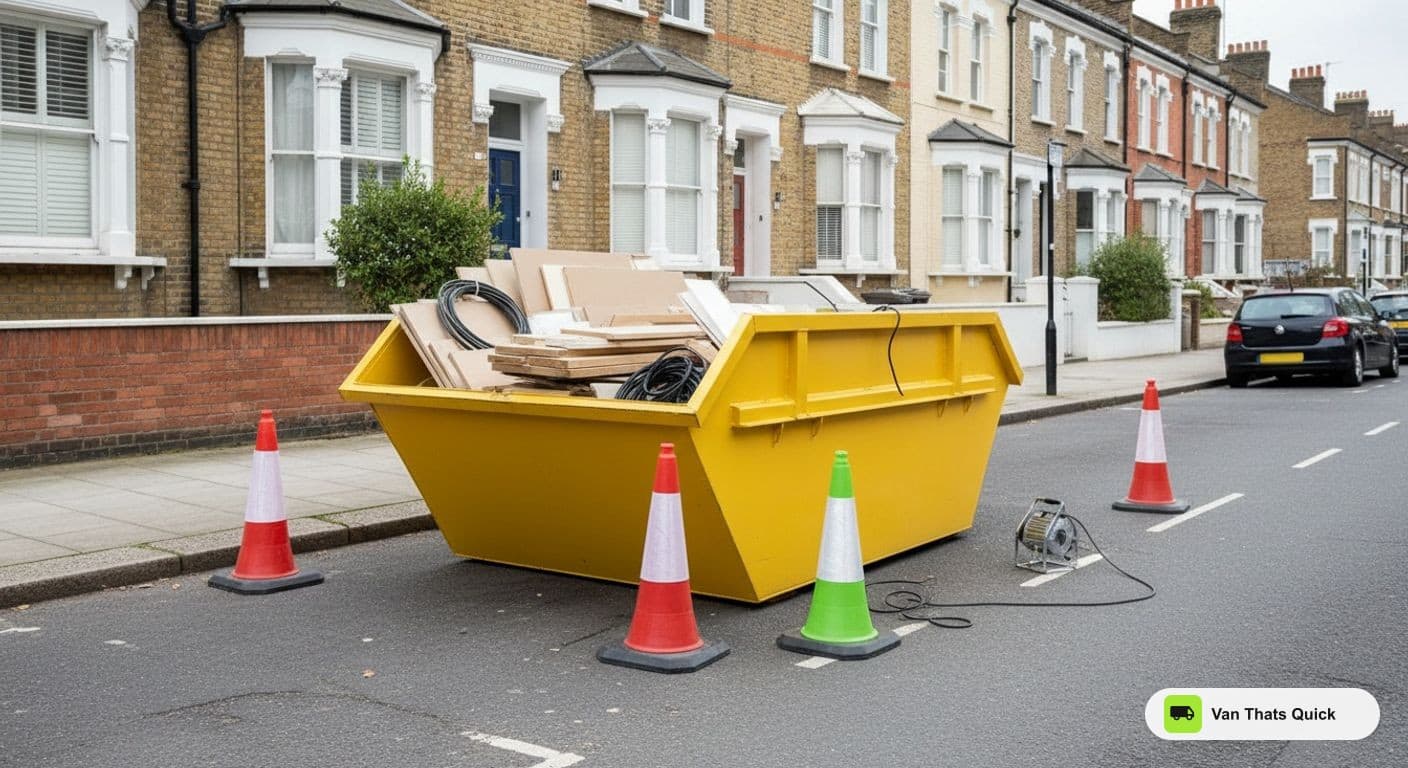
"Maxi skip" is the informal name for the large end of the skip range - the open-top containers of 10 cubic yards and up, running through 12, 14 and 16 yards. To picture the scale, a 16-yard maxi skip is roughly the size of two large builder's skips joined together and stands well over head height. They dwarf the mini and midi skips most households use, and they are a completely different proposition to hire.
The defining feature of a maxi skip is not just its volume - it is what that volume is for. These skips are engineered for materials that take up a lot of space but weigh very little: think shop or office strip-outs, bulky household clearances, packaging, light timber, cardboard and general low-density junk. They are emphatically not built to be filled with heavy, dense waste, and understanding why is the single most important thing in this guide.
Volume vs weight
A skip's yardage measures volume, not the weight it can carry. On a maxi skip, weight is the real limit - and it caps out long before the container looks full of anything dense.
What Are the Maxi Skip Sizes and Capacities?
Large skip sizes are measured in cubic yards. The bin-bag figures below are a rough guide for light, bulky waste only - the kind of material these skips are designed to take. Load anything heavy and you will hit the weight limit long before you reach these volumes.
| Skip Size | Rough Bin-Bag Capacity | Weight Guide | Suitable Waste |
|---|---|---|---|
| 8-yard (for comparison) | 60–80 bags | Mixed / some rubble OK | The largest skip that can still take heavy waste |
| 10-yard Maxi | ~100 bags | Light waste only | Bulky, low-weight clear-outs |
| 12-yard Maxi | ~120 bags | Light waste only (~5t cap) | Strip-outs, large clearances |
| 14-yard Maxi | ~140 bags | Light waste only (~5t cap) | Commercial & retail clearances |
| 16-yard Maxi | ~160 bags | Light waste only (~5t cap) | Big bulky, very low-density loads |
As a rule of thumb, a 10-yard skip can hold the equivalent of around ten tonnes' worth of light bulky waste, and a 12-yard around twelve tonnes' worth - but only if that material is genuinely low-density. Those figures never apply to soil, rubble or hardcore, which is exactly where people come unstuck.
Why Can't You Put Soil or Rubble in a Maxi Skip?
This is the gotcha that catches out DIYers, landlords and even some builders. The reason big skips are light-waste-only comes down to physics and the law, not fussiness. When a skip lorry collects a full container, its hydraulic crane has to lift the entire loaded weight off the road. A 12, 14 or 16-yard skip hits a working weight limit of roughly 5 tonnes - and dense inert waste blows straight through that limit.
Soil, sand, shingle, hardcore, bricks and concrete are extraordinarily heavy for their volume. Fill even a third of a maxi skip with rubble and you can already exceed what the lorry is rated to lift. If the driver tries anyway, the crane physically cannot pick it up, or the strain damages the vehicle, the driveway or the road. For that reason, most operators simply refuse soil, rubble, hardcore, bricks and concrete in any skip bigger than about 8 yards.
The rule that saves you a wasted delivery
If your waste is heavy and inert - soil from a garden dig, broken concrete, bricks, tiles, hardcore - the biggest skip you can actually use is normally a 6 to 8-yard builder's skip. If your waste is light and bulky - furniture, timber, packaging, general junk - then a maxi skip is fair game. Mixing the two, or hiding rubble under light waste, is the fastest way to a refused collection and a surcharge.
Here is the simple decision, side by side:
| Your waste is… | Examples | Largest suitable skip |
|---|---|---|
| Heavy & inert | Soil, sand, shingle, hardcore, bricks, concrete, rubble | 6–8-yard builder's skip |
| Light & bulky | Furniture, timber, cardboard, packaging, general junk | 10–16-yard maxi skip |
If you have a genuinely mixed job - some rubble plus a lot of bulky junk - hiring one huge skip is usually the wrong move. It is often cheaper and simpler to keep the heavy material in a small builder's skip and clear the bulky items with a man and van, or to skip the container entirely and let a crew sort and load everything in one visit.
Which Jobs Actually Need a Maxi Skip?
Given the weight rule, a maxi skip earns its keep on a narrow set of jobs - large volumes of light, bulky material generated over time. Typical examples include:
A good fit
- Shop or office strip-outs
- Large house or estate clearances
- Loft and garage clear-outs
- Light timber and joinery offcuts
- Packaging, cardboard and shop fittings
Wrong tool for the job
- Soil from garden landscaping
- Broken concrete or patio slabs
- Bricks, blocks and rubble
- Bathroom or kitchen rip-out debris
- A single sofa or fridge (far too big)
A maxi skip only makes sense when three things are true at once: the waste is light, there is a genuinely large volume of it, and it builds up over days so a permanent on-site container is useful. Take away any one of those and a smaller skip or a man-and-van collection is almost always the better call. For a garden project, our garden waste removal service handles green waste and soil without the weight headache; for a full property clear, a house clearance takes everything in one organised visit.
There is also a practical London problem: maxi skips are enormous, and very few driveways can fit a 12-yard skip. That means they almost always have to go on the road - which brings us to permits and prices.
How Much Does a Maxi Skip Cost in London?
In London, maxi skips typically cost from around £350 to £550 or more in 2026, with the central boroughs sitting at the top of that range. London runs consistently above the national average because of higher tipping fees, congestion and operating costs. A 16-yard skip costs more than a 10-yard, but the gap is smaller than you might expect, because most of the price is delivery, disposal and the licensed tip - not the container itself.
The permit almost every maxi skip needs
Because a maxi skip nearly always sits on the road, you will usually need a council skip permit. Across London these typically run £30–£120, averaging around £68 and reaching up to £165 plus VAT in some boroughs, and last one to two weeks. A skip placed entirely on private land needs no permit - but almost no driveway fits a 12-yard skip.
On top of the permit, there is a second charge that catches people out in inner London. If the skip takes up a resident or pay-and-display parking bay, you also pay to suspend that bay:
- Parking bay / CPZ suspension: averages around £43 and ranges from £16 to £130, depending on the borough and the number of days.
- Space to land it: a maxi skip needs a big, clear stretch of road - a real constraint on narrow terraced streets in boroughs like Ealing, Hammersmith and Brent.
- Lead time: permits are not instant. Some boroughs need several working days' notice, which matters if you are on a deadline.
For a fuller borough-by-borough breakdown of every skip size and permit, see our London skip hire cost guide. If your load is small enough that a maxi skip feels like overkill, our mini skip hire guide covers the other end of the range.
Maxi Skip vs Man and Van: Which Is Better?
A maxi skip is a big fixed-price container that you fill yourself over days, on the road, under a permit. A man-and-van clearance is labour-included, permit-free, and you pay only for the space your waste actually fills. For most bulky clear-outs the comparison looks like this:
| Maxi Skip | Man & Van Clearance | |
|---|---|---|
| Council permit needed? | Yes, almost always | Never |
| Who loads it? | You do | The crew does |
| You pay for | Whole container | Only what's taken |
| Road space needed | Large, for days | A brief park |
| Heavy rubble? | Banned in maxi sizes | Small amounts OK |
| Best for | Long strip-outs, steady light waste | One-off bulky clear-outs |
A maxi skip wins on one specific job: a long project generating a steady stream of light, bulky waste where you want a huge container permanently on hand. For almost everything else - a loft or garage clear-out, an office of old furniture, a flat full of junk before a move - a man and van is faster and usually cheaper once the permit, the bay suspension and your own days of loading are counted. And unlike a maxi skip, a crew can take an old sofa disposal or a fridge without a per-item skip surcharge.
Van Thats Quick works right across London and West London, from Uxbridge and Hillingdon through Ealing to the central boroughs. Man-and-van waste collection starts from around £95, with man-and-van rates from about £89 per hour - no skip, no permit, no week-long wait on your kerb. For a full breakdown of what a job costs, see our guide to man and van prices in London.
Your Legal Duty of Care (Don't Skip This)
Whether you go with a skip or a collection service, one legal point applies to every London householder. Under Section 34 of the Environmental Protection Act 1990, you have a "duty of care" for your waste - you must only hand it to an authorised, registered waste carrier.
Why it matters to you
If you pay a cheap "man with a van" who then fly-tips your waste, and investigators trace it back to your address, you can be fined - even though you did not dump it. Councils can issue a fixed penalty of up to £600 for a household duty-of-care breach, and a case taken to court carries an unlimited fine. Fly-tipping itself now carries fixed penalties of up to £1,000. "I didn't know" is not a defence if you failed to check.
The takeaway: always ask any waste carrier for their Environment Agency registration before they take your rubbish. A legitimate operator will give it without hesitation and dispose of your waste at a licensed facility.
Before booking a waste collection: ask us to identify the registered carrier handling the job and provide the registration details. Verify those details on the Environment Agency public register before handing over any waste.
Big Bulky Clear-Out Without the Maxi Skip
No permit, no bay suspension, no huge container blocking the road for a week - our crew does the lifting and only takes what you actually need gone. Man-and-van waste collection across London from ~£95, with man-and-van rates from around £89 per hour.
Maxi Skip Hire: Frequently Asked Questions
What sizes are maxi skips?
Maxi skips are the large skip sizes: 10, 12, 14 and 16 cubic yards. A 16-yard maxi skip is roughly the size of two large builder's skips. They are designed for light, bulky waste only, not heavy material.
Can I put soil or rubble in a maxi skip?
No. Soil, rubble, hardcore, bricks and concrete are far too heavy. A full 12, 14 or 16-yard skip hits a weight limit of roughly 5 tonnes, and dense material exceeds that long before the skip looks full - so the lorry cannot lift it. For heavy inert waste, the largest usable skip is normally a 6 or 8-yard builder's skip.
How much does a maxi skip cost in London?
In London, maxi skips typically cost from around £350 to £550 or more in 2026, with central boroughs at the top of the range. Because a maxi skip nearly always sits on the road, you should also budget for a council permit of roughly £30–£120, plus a parking-bay suspension in controlled zones.
Do maxi skips need a permit?
Almost always, yes. A maxi skip is too big for most driveways, so it goes on the road and needs a council skip permit (typically £30–£120 in London). Only a skip placed entirely on private land avoids a permit - and very few driveways can fit a 12-yard skip.
What is the biggest skip I can hire for heavy waste?
For heavy inert waste - soil, sand, shingle, hardcore, bricks, concrete and rubble - the largest skip you can normally use is a 6 to 8-yard builder's skip. Anything bigger cannot be lifted safely when filled with dense material, so operators refuse heavy waste in maxi skips.
Is a man and van better than a maxi skip?
For a one-off bulky clear-out, usually yes. A man and van collection needs no permit, includes all the loading, doesn't block the road for a week, and charges only for the waste removed - from around £95. A maxi skip makes more sense for a long project producing a steady stream of light waste.
Can I be fined for someone else fly-tipping my waste?
Yes. Under your Section 34 duty of care, if you hand waste to an unregistered carrier who then dumps it, you can face a fixed penalty of up to £600, or an unlimited fine in court. Always check your carrier is registered with the Environment Agency.
Too Much to Clear for a Small Skip?
Tell us what you need gone and we'll give you an honest, all-inclusive price. No permits, no loading, no giant skip parked on your street for a week.